The mindset shift that makes fitness a lifelong habit is simple: stop chasing a result and start protecting a routine so small you can’t talk yourself out of it. A ten-minute walk you take every day beats a boot camp you quit by March. Here’s how to make that switch, step by step, without spending much.
Published November 10, 2026.
Here’s where I’m coming from. I’m not a trainer, and I won’t hand you a six-week shred. I’m someone who fits movement around a job, a grocery budget and a calendar that never has a free hour in it. That’s most of us. So this is the version of fitness that survives a busy Tuesday.
Why a fitness habit usually falls apart
Most plans die the same way. You start big. Five days a week, an hour each, new shoes, new playlist. Then a kid gets sick or work runs late, you miss two days, and the whole plan feels ruined. So you drop it and wait for the next Monday.
The problem isn’t willpower. It’s the deal you made with yourself. If exercise is a payment toward a goal weight or a wedding dress, it stops the day the goal feels far away. If it’s a punishment for last night’s pizza, you’ll avoid it like any other punishment. Nobody keeps a habit they resent.
The shift: from a result to a fitness habit you keep
The switch is to care more about showing up than about how hard you went. You’re not trying to get fit by spring. You’re becoming a person who moves most days. That sounds soft. In practice it changes every choice you make, because a person who moves most days doesn’t need a perfect plan. She needs a minimum.
There’s research behind the patience part. A University College London study published in the European Journal of Social Psychology followed 96 volunteers building a new daily habit. On average it took 66 days for the behavior to feel automatic, with a range from 18 to 254 days. Missing a single day didn’t knock people off track. That’s the most freeing finding in fitness, if you ask me.
So give it two months before you judge it. And give yourself permission to have a bad day.
How to build a fitness habit, step by step
Here’s the routine I’d hand a friend who keeps restarting. Do the steps in order.
- Pick your minimum. Choose a version so small it feels almost silly: ten minutes of walking, or one round of squats, push-ups against the counter and a plank. This is the floor, not the goal.
- Attach it to something you already do. Right after you drop the kids at school. Right after your first coffee. A habit with a fixed trigger is easier to repeat than one floating somewhere in your day.
- Set it up the night before. Shoes by the door, clothes on the chair, band on the couch arm. Every bit of friction you remove is one less excuse at 6:45 a.m.
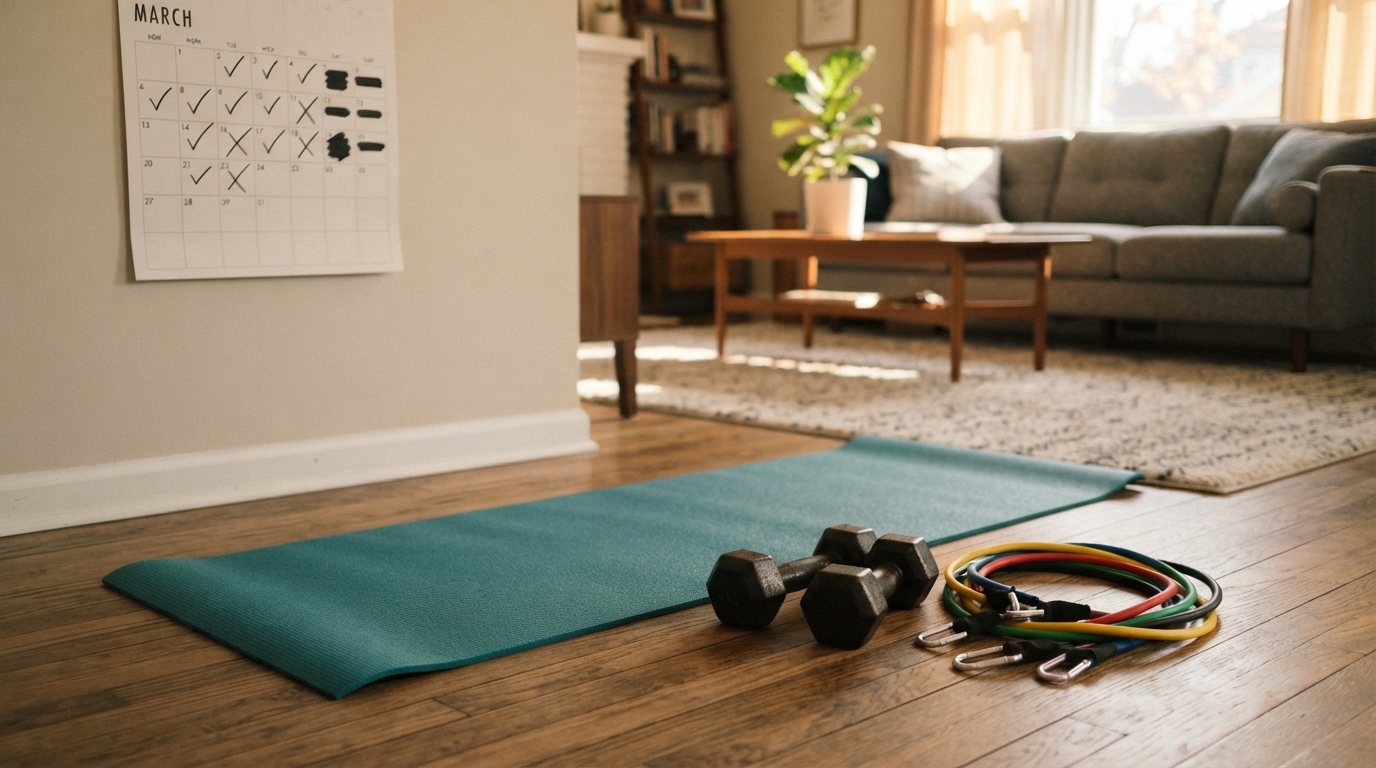
- Track the days, not the details. A check mark on a paper calendar is enough. You’re counting showing up, not reps or miles.
- Add only after it’s boring. Once the minimum feels automatic, stretch it to fifteen or twenty minutes. Not before.
- Plan your bad-day version. Decide now what counts on a terrible day. Five minutes of stretching counts. So does a lap around the block.
If mornings are your slot, our simple morning stretches make a gentle bad-day version all by themselves.

Drugstore or splurge: what’s worth buying
You don’t need to buy your way into a habit. In fact, a big purchase can backfire, because it turns the gear into the goal. Here’s where I’d save and where I’d spend.
| Item | Drugstore or splurge? | Why |
|---|---|---|
| Walking or training shoes | Splurge | Fit matters more than anything else you’ll buy. Get them fitted at a running store if you can. |
| Resistance bands | Drugstore | A basic set covers most home strength moves and packs into a drawer. |
| Dumbbells | Drugstore or secondhand | Weight is weight. Marketplace listings are full of barely used sets. |
| Yoga or exercise mat | Drugstore | A plain mat does the job. A towel on carpet works in a pinch. |
| Fitness tracker or smartwatch | Wait | Buy one after the habit sticks, as a reward. Before that, a paper calendar works fine. |
| Gym membership | Depends | Worth it only if the gym sits on your daily route. A gym ten minutes out of your way gets skipped. |
| Boutique classes | Occasional splurge | Great for a fun treat or learning form. Pricey as a main plan. |
My one firm splurge is shoes. Sore feet end more walking habits than boredom does. Everything else can be cheap, borrowed or skipped.
A starter week for your fitness habit
This week is built around the minimum, with a little variety so you don’t get bored. Each day takes 10 to 20 minutes.
- Monday: 10-minute brisk walk.
- Tuesday: Band circuit. Ten squats, ten band rows, ten counter push-ups, a 20-second plank. Repeat twice.
- Wednesday: 10-minute walk plus five minutes of stretching.
- Thursday: Band circuit again.
- Friday: Your choice. Dance in the kitchen, bike, swim, anything that moves you.
- Weekend: One longer walk, 20 to 30 minutes, and one full rest day.
Down the road, the CDC recommends that adults get 150 minutes of moderate activity a week plus two days of muscle strengthening. You don’t have to hit that in week one. Think of it as where the habit is headed, not the entry fee. When you’re ready for more cardio, our list of low-impact cardio workouts is an easy next step.
Before and after: what changes in real life
Forget the dramatic transformation photos. The before-and-after that matters is how your week feels.
Before: Exercise is an event. You need the right outfit, a free hour and a good mood. Missing a day means the plan is over. Monday is always the restart.
After: Exercise is a default. The shoes are by the door, the walk happens after coffee, and a busy day just means the short version. You stop asking whether you feel like it. You stop restarting, because you never fully stopped.
The practical win is time. You stop spending energy deciding, negotiating and feeling guilty. That’s energy you get back for everything else.
When your fitness habit slips
It will slip. Holidays, colds, a brutal work month. The goal isn’t a perfect streak. It’s a short gap. My rule is to never miss twice in a row if I can help it, and on day two, the bad-day version counts.
Rest days are part of the plan, too. If you’re not sure whether you need a day off or just an easy one, our guide to active recovery and rest days explains the difference. And if you’ve fallen off for weeks, the fall fitness routine reset walks you back in gently.
Frequently asked questions about building a fitness habit
How long does it take to make exercise a habit?
Longer than the internet’s 21 days. The UCL study found an average of 66 days, and some people took much longer. I’d plan on two to three months and stop judging yourself before then.
Do I need a gym to build a fitness habit?
No. Walking and a set of resistance bands cover a lot of ground. A gym is worth paying for only if it sits on a route you already travel, so getting there doesn’t become its own workout.
What if I only have ten minutes?
Then ten minutes is your workout, and it counts. Short sessions are how the habit gets built. You can stretch them later once the routine feels automatic.
Will a smartwatch keep me motivated?
Maybe, but it won’t build the habit for you. Plenty of trackers end up in a drawer next to the old jump rope. Save it as a reward for your first two months. By then you’ll know whether you’ll actually wear it, and you’ll have earned the splurge.
Got a trick that finally made exercise stick for you? I’d love to hear it in the comments.
This article is for general information and is not medical advice. Check with your doctor before starting a new exercise routine, especially if you have a health condition.